

Google Blocking Users from Search Results with Automated Queries Error
The Unexpected Block

“We’re sorry… but your computer or network may be sending automated queries…”
Recently, a colleague shared an experience of being temporarily barred from conducting basic Google searches. The block lasted for approximately 4 hours. The reason? Google believed he was searching too rapidly. I was a little mystified and perplexed.
The Automated Query Error Message
The situation escalated when several days later our network experienced the same issue. Instead of the usual search results, we were greeted with this message: “We’re sorry… but your computer or network may be sending automated queries. To protect our users, we can’t process your request right now.” It then provides a link to a Google support page regarding the blocking issue which incidentally does not address the problem.
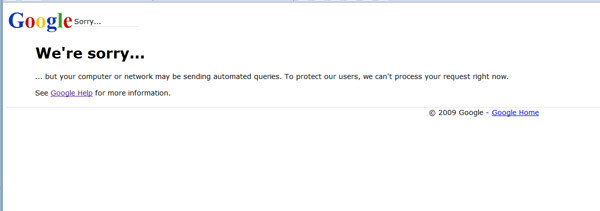
Google’s warning that you have been blocked from making search queries.
At this point, the frustration level was increasing and beginning to get the better of me. A quick walk outside for some fresh air soon restores my inner calm. We resort to using Microsoft’s Bing to search for some answers to our now pressing and immediate problem.
Troubleshooting Google’s Blocking of Search Results
Being cautious about malware, we ensure our computers and servers are always clean. Despite our confidence in our security measures, we followed Google’s advice. We used the ‘HiJack-This’ program, which helps identify and remove malicious items. Even after adhering to Google’s recommendations, the problem persisted.
Interestingly, one of our computers regained access to Google search results, not because of the troubleshooting steps, but due to a change in its IP address after being switched off for a while – it was the only computer that was outside of our static network.
Captcha Code Issues
Further research revealed that we weren’t alone in facing this issue. It wasn’t just about ‘searching too fast’. On occasions, rapid searches triggered Google’s Captcha Code, which required manual input to continue. For businesses heavily reliant on the Internet, this is a significant disruption.
Google says if the problem persists then “your network administrator should contact us”. They provide a link for additional information. Once there you fill out your name, email address, country, IP address, number of users affected, and date Google started blocking. You cannot submit that address if you do not submit your IP!
The Potential Culprit – SEO Reporting Software
One theory we considered was that our SEO and PPC reporting software might be the root cause. The software frequently queries Google, potentially giving the impression of an aggressive search bot.
The Solution – Private Proxy Servers
To avoid interruptions, we found that using parallel private proxy servers was effective. These servers allow automated software to run multiple reports simultaneously, switching between IP addresses. If one IP gets blocked, the software shifts to another, ensuring tasks are completed. Depending on the frequency of reports, the number of private proxy servers needed may vary. We recommend starting with 10 for those using SEO software. Opting for private proxy servers over public ones reduces the risk of early blocks.
For our needs, we collaborated with Junaid at Corgitech for VPS and Trusted Proxies for proxy servers. Both companies provided excellent support and were instrumental in addressing our concerns.
Understanding Google’s automated systems and taking proactive measures can ensure smooth, uninterrupted searches that don’t fall afoul of their blocking system.






Is this still happening to you? I came here looking for a solution as the same happened to me several times in the last week. Google does not respond to support request. If you something better please tell me.
Hi!
I also faced the problem that Google was blocking my manually done websearch!
Google’s websearch was totally unusable for me! I had to reset/remove all cookies after every single search-request I did!
Here is my solution: Using Safari you have to install some cookie-blocking extensions (I installed Ghostery and SafariCookies) and set them to block cookies from www. google.com (or whatever Goolge-search-domain you’re using).
Using Firefox you have to setup cookie-blocking for http://www.google.com (or other domain) using firefox’ preferences.
Now I am able to use the Google websearch again…
Thanks for the info. We are still looking at various options including VPS solutions. I am going to try your solution for Firefox and see if I get any results from it.
Thanks
I’m still getting this error on my iPad using Dolphin Browser. Strange thing is, Safari on iPad works fine. Also, the date on the page I get is still 2009.
I am getting blocked by google as well while attempting to search.mmi am a single user using the AT&T network with an iPad. I am not doing anything fancy. I have had to use either Yahoo or Bing to look for something – and most of my inquiries are quite simple. I am 76 years old and don’t need the irritation and frustration this causes. If I am going to be blocked, then I should be afforded the capability to get in touch with some one from Google.
Do all those programs Google say to run work on an iPad?
Thanks
Betty, try clearing your cookies and cache.
To do it on the ipad, if you are using Safari, go into Settings, then hit “Safari” then hit “Clear Cookies and Data” (note: this will sign you out of stuf like Facebook etc).
Hope this helps 😉
Since we wrote this post, several months have gone by and in this time we have switched to a dedicated IP address and moved over to BT’s business fibre service. When that happened the Google blocking stopped. We cannot figure out why this happened, no one here was using automated software to search Google’s search engine and we can only surmise that it is possibly a public IP. However this doesn’t quite add up either.
We are still hoping that whoever is in charge of that department will start reading their emails.
I am using a vpn from china and I have the same problem.
Do some of you also use vpn? Might this problem be related to my ‘jumping’ to several IPs everytime I try to elude the ‘great Firewall’ and go check my fb and watch youtube?
thanks
s
Yeah I am currently in korea and i got the same message after i tried to intall a VPN application on my.pc to stream movies. I hope that was why I got the warning and not because someone actually did hack into my network
Got the same problem using Dolphin on my Android phone. Perhaps if enough people vote with their feet, Google might start paying attention.
Same problem with my iphone using the safari browser. I have been in touch with AT&T support and Apple support, no one knows what is causing it or how to solve it. Google offers no assistance and the suggested solution on their link does not apply to mobile iphone users (installing malware protection software). This problem has been coming and disappearing for a good 6 months now, sometimes it last hours and some times it lasts days. Currently it’s been at least 2 weeks straight of being blocked from google. The only solution I have found is switching to Bing. Way to go Google!!
Same thing happening to me here in the US on the AT&T network. Sort of ridiculous because I would imagine I am sharing an IP address with quite a few people. The suggested google fix as mentioned does obviously not apply to mobile devices as well so I have no idea what to do. Tried clearing history and cookies etc. turning off VPN. tried deleting the google app. Nothing. So now I am just using another browser. As James says-way to go google.
Having same problem with Dolphin browser on my GSIII. Dolphin AND Google about to lose another user.
For a single computer its fine to clear cookies and clearing cache.
But in a work-group of 35-40 Computers How can i solve this problem ??
In this Group browse are using with page rank, Web rank, seo tool-bars, alexa traffic, moz-bar plugins and extensions are using they are unable to work with out these toolbars.
How can i Fix Google Search “We’re Sorry” Error Pages
i am facing same problem with Google Search Engine….”we are sorry..”
any one can tell me any solution for my SEO Business… i have 50 employee. every one face that’s type of problem..
We have now updated the article with a solution for the problem – read from the heading “Solutions to the problem…” The problem as we believe is SEO reporting software with too many automated queries.
What SEO reporting software are you using? Do you still experience the same problems now?
We are no longer experiencing these problems, and have not for a while.
Thanks for the post on this. I was pulling my hair out, but guess I will just switch my IP address again.
I’m a marketing and SEO writer – but I am not running around everywhere checking page rank and such. I am using the Chrome ‘Page Rank Status’ tool, and I usually have a huge number of tabs open, but this is a clean install, with no such issues.
The thing is, I am having the same problem when using my VPN (Strong VPN), but when I do not use the VPN, no problem. So it can’t be cookie or application specific, since just changing the IP makes the issue go away, as you discovered.
Guess I will switch my IP again :/
I am a novice user using a VPN to watch US TV, i have to turn off VPN to search, When VPN is off google search works fine.
Hi,
it happened to my iphone today and I was getting the message posted at the top of this webpage.
Incidentally, this problem appeared soon after I’d downloaded runkeeper ap, so deleted the ap from my iphone and the problem was solved : ).
Sal
I’m a network administrator for our company and we recently ran into this issue. We previously thought that it was due to a program called Inspyder Insite. But after reviewing a packet capture in our primary router/gateway, I found that there was a lot of traffic directing to the Google IP addresses from one particular user. After reviewing these packets, I noticed that they were coming from Mozilla (Firefox) and using the following request:
“GET /search?client=navclient-auto&features=Rank&ie=UTF-8&ch=111111111&q=info:http%3A%2F%2Fwww.mymonthlytraffic.com%2Fsupport.php HTTP/1.1 ”
This, along with other sites not just mymonthlytraffic.com, directed me to check the user’s Firefox Add-ons. I then found quite a few add-ons that were enabled, including web rank, aleza, etc. After disabling these, our Google searches went back to just captchas, then after a few minutes we got normal search responses.
I hope this helps.
-Renato
Hi Renato, interesting information and we will check this out. I had not considered that plugins could be what is causing/caused the issues. We use SEO toolbar, and a couple of search related tools to help us search internationally. Not sure if any of thsoe could be the issue as we had also delted quite a few when I reloaded our browsers recently.
Thanks for the heads up
Vincent
This started happening to me on my HTC phone about a week ago. If I am at home using the phone on my WiFi I can search on google but if I am using my 3G connection (not sure of proper terms here) I get the Google sorry page shown above. Have tried clearing history, cookies, cache, etc but nothing has solved it & I have no idea why it happened in the first place. Would really appreciate it if someone could give me some advice. I don’t know where to turn.
‘Bots’, ha.
Google likes to know exactly who’s using their search engine so they can supply their browsing activities straight to Prism.
So they block people using vpn’s.
As most everyone here, I was having this same issue but found a different solution. First, I am behind a very large corporate network and I do not have access to the Proxy Servers or routers to look in to their logs, activity or what-have-you so that wasn’t an option for me.
Solution: ipconfig /flushdns
I tried all the clearing cache and the like mentioned above but it was not until I went to the command prompt and typed ipconfig /flushdns that I got the captcha, entered it and am working again. Hope this helps others if the other, very thorough solutions do not.
To agree with ur freind “top of post” it can happen by searching google to fast as tht is exactly what happened to me my block laster for 15 minutes and then stope showing capcha’ss all together i did a series of of 100 plus searches “yes flipping throguh pages counts in googles eye’s” and this happened to me 27 hours hasnt happend again
Lol,
i had that for a while right at the start, i then just clicked at “home” and got the websearch again.
Curiously as I am, i tried to figured out what it was and one won’t believe it- it was my firefox browser which i had to “google.com” as a startup page.
naturally the first address it called “automatically” was the one from google.com and dash…i got the “block” message.
Maybe google should start thinking a little before running “automated” blocking protocols.
It doesn’t happen with Bing, Yahoo or other engines as “start engines in firefox.
Most likely it will also not happen with google chrome, but… nope they cant force me to use their browser.